An S50 mosaic image

Flame and Horsehead Nebulae

This is an image from the SeeStar S50 captured around October 27 2024 in alt-az mode with mosaic imaging. Mosaic imaging means that the image is larger that the normal capture frame (in this case, about twice as big) so the system captures a number of images around the central frame and then merges the images together for the final picture. Alt-az means the telescope is oriented with axes pointed to the zenith and parallel to the horizon.

This is a fairly noisy image and took quite a while to capture, but you will note that there are no obvious rotational artefacts. The S50 first captures a central image, then spirals in a clockwise direction to fill in the edges, with the process repeating until capture is stopped. The central part of the image is therefore captured multiple times with the edges of the frame having a lesser number of captures. Image captures were eventually blocked by the house, so the time was somewhere around 22 minutes for the entire process – not a particularly long time.

I’m trying to set the same region up for an equatorial mode capture, but the Horsehead Nebula is a little south of the equator, and one limitation of the SeeStar software used in equatorial mode is that objects below the celestial equator are considered as being below the horizon and can’t be captured. There may be workarounds…

Even though this is a noisy capture, you can see that the dark Horsehead is superimposed over a brighter red glow caused by hydrogen gas ‘excited’ by the light of nearby stars. On one side the number of stars is much higher than on the other: the darker area is covered interstellar dust which blocks the light from stars in the background. There’s a lot of dust in this area, and longer exposures will reveal more details – the dust reflects a little light from nearby stars, but not enough to be seen in this short capture.

For a comparison, the image below was captured in December 2023 with the default Seestar framing.

/
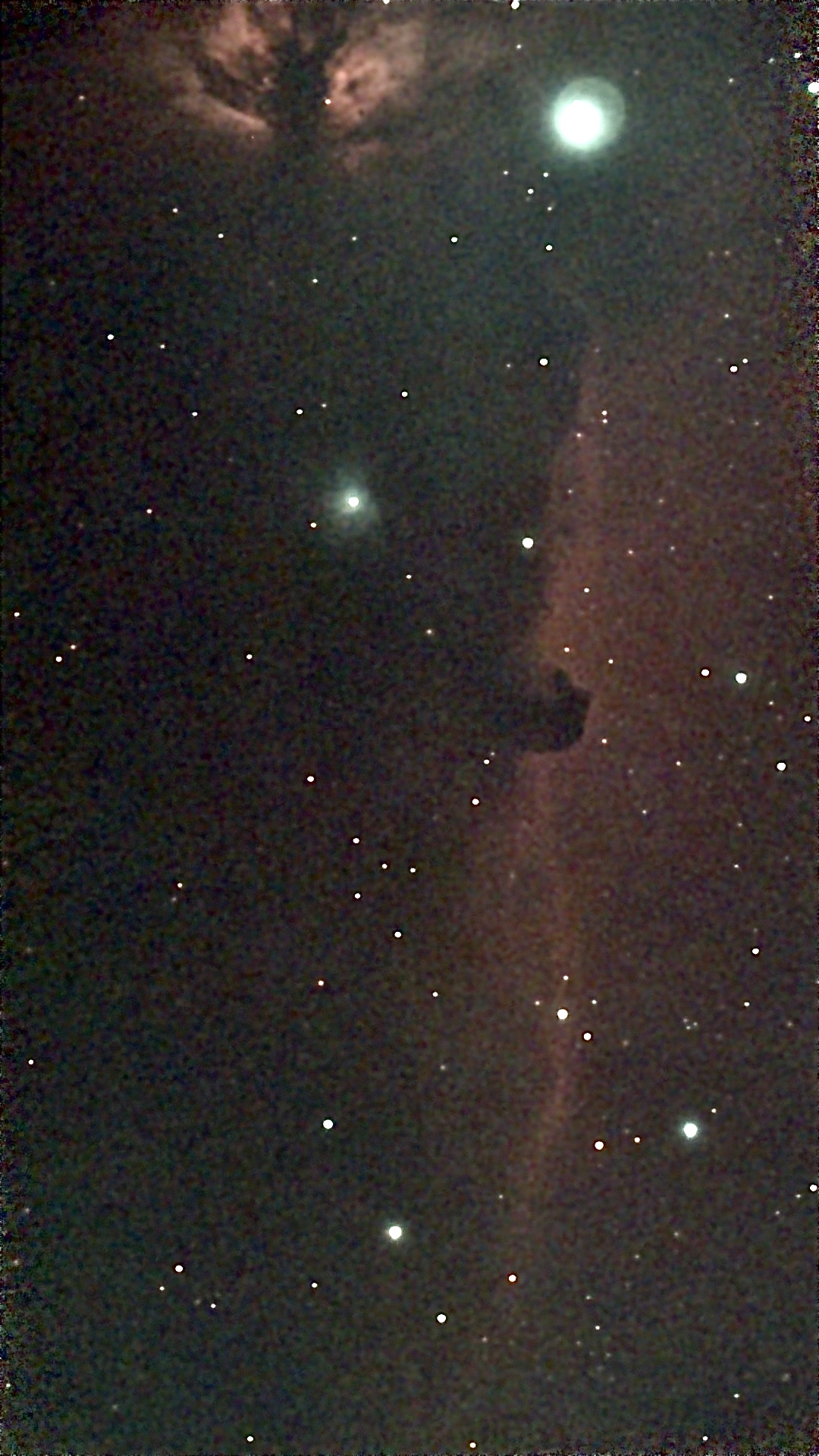
Same general area, but smaller size frame.

[Note that clicking on the images should increase the magnification so you can pixel-peep]
Gearing up!

At the end of the year I picked up a SeeStar S50, a “smart telescope” which under the control of a mobile phone (recent models of iPhone or Android) can collect and process Astronomical images more or less on demand. Even under the light dome of a major city (Bortle 8 or 9 in my suburban location, depending on the night) it can punch through the city murk and give you an image of places so far away that mankind wasn’t even a twinkle in an Australopithecus’ eye when the light left that far-away place. That’s not as remarkable as it sounds, since anyone far enough away from a city can do the same thing just by finding the most visible galaxy (M31) in Andromeda (there are in fact many galaxies in every part of the sky, but M31 is both large and bright since it’s close to us). If you do that, you’re looking back in time.

What is remarkable is that the S50 can do that even in the bright lights of a city, taking a series of brief exposures and then adding the signals of the light captured by each sensor in each image, compensating for the murky atmosphere and bright city light, and from that creating a final image of what could have been visible before. [This is not AI. It is a lot of work done faster by a computer than a human could have done without getting exceedingly numbed by the boredom of the task.] Intelligence came into play in the design of the process, and comes further into play when the automatically captured image is then enhanced by a human being (adjusting contrast, colour balance, saturation, brilliance, etc. for esthetic reasons). For those who’d like to complain that it’s been “photoshopped” I will point out that a lot of published photographs are adjusted this way and have been for many years before Photoshop lurched its way out of a computer science lab. Check out Ansel Adams’ prints which were worked on for days and weeks until Adams was satisfied with the way they looked. It’s not fakery, it’s Art.

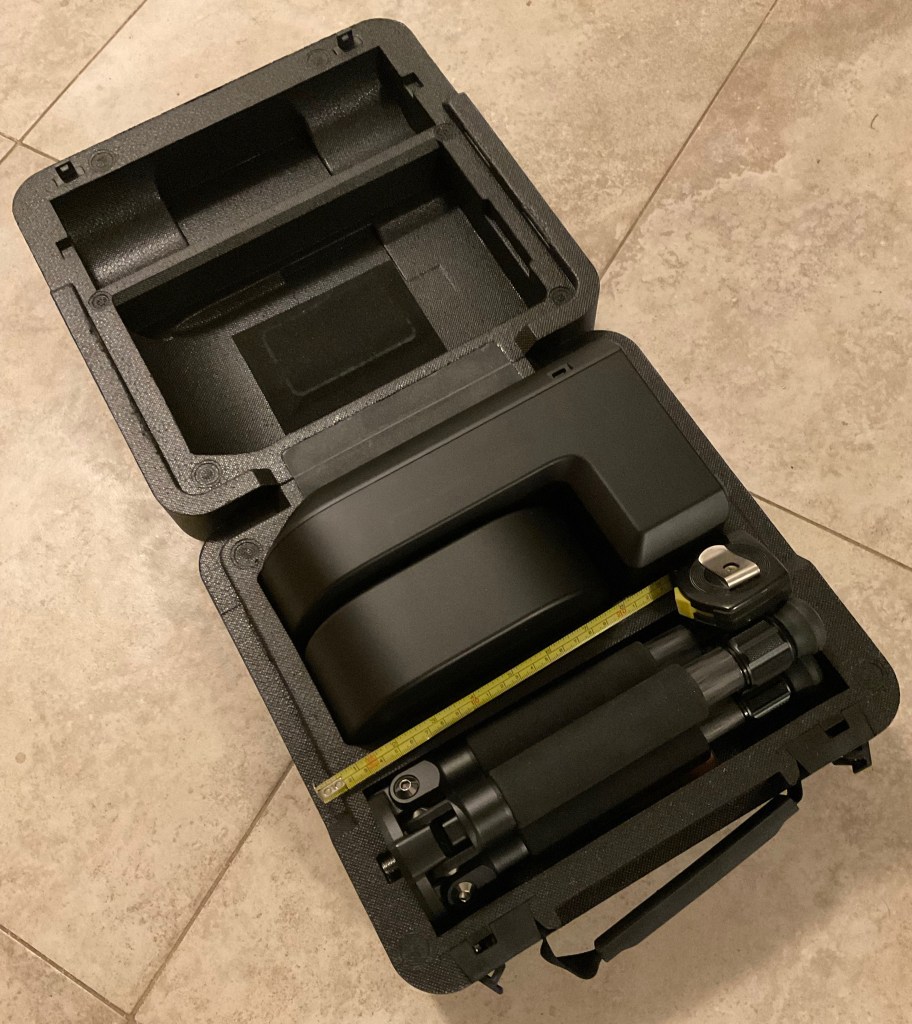
SeeStar S50 in its case (included). There’s a small tripod and underneath that, a solar filter.The tape measure is shown for scale. Motors and computer are in the L-shaped section, but the telescope and camera are folded into the smaller black box.

So, back to the S50 and its automatic long exposures… The S50 is a 50mm refracting telescope which is folded (with mirrors, or rather, a prism) so the light is kept within a 5”x7”x2½” black box which also contains a camera sensor. The sensor captures an image and sends it to a computer which processes it—while also controlling motors to keep the telescope pointing at the same point in the sky for as long as the operator-imager wants to keep taking pictures. And it doesn’t do a bad job of processing the image—which can, as noted, be further improved to the imager’s satisfaction with a little additional computer help. The image from this 50mm telescope is several levels better than can be seen with the naked eye because of the long effective exposure (which captures stars too dim to be seen with a naked eye view through the same scope) and the computer program (which helps remove the bright light of the city, murky city skies, and even some very light clouds which may obscure parts of the image during the long series of exposures.

The S50 is not the only “smart telescope” around. There are others, at prices ranging from hundreds to thousands of dollars, and with varying abilities. Since they are computer driven they can be improved by improving the computer programs, and, at least for the S50, those improvements are sent over the internet, without charge (so far, no subscription fees [my current bête noir]).

More to come in following posts …with images and additional equipment updates!

AllSky image

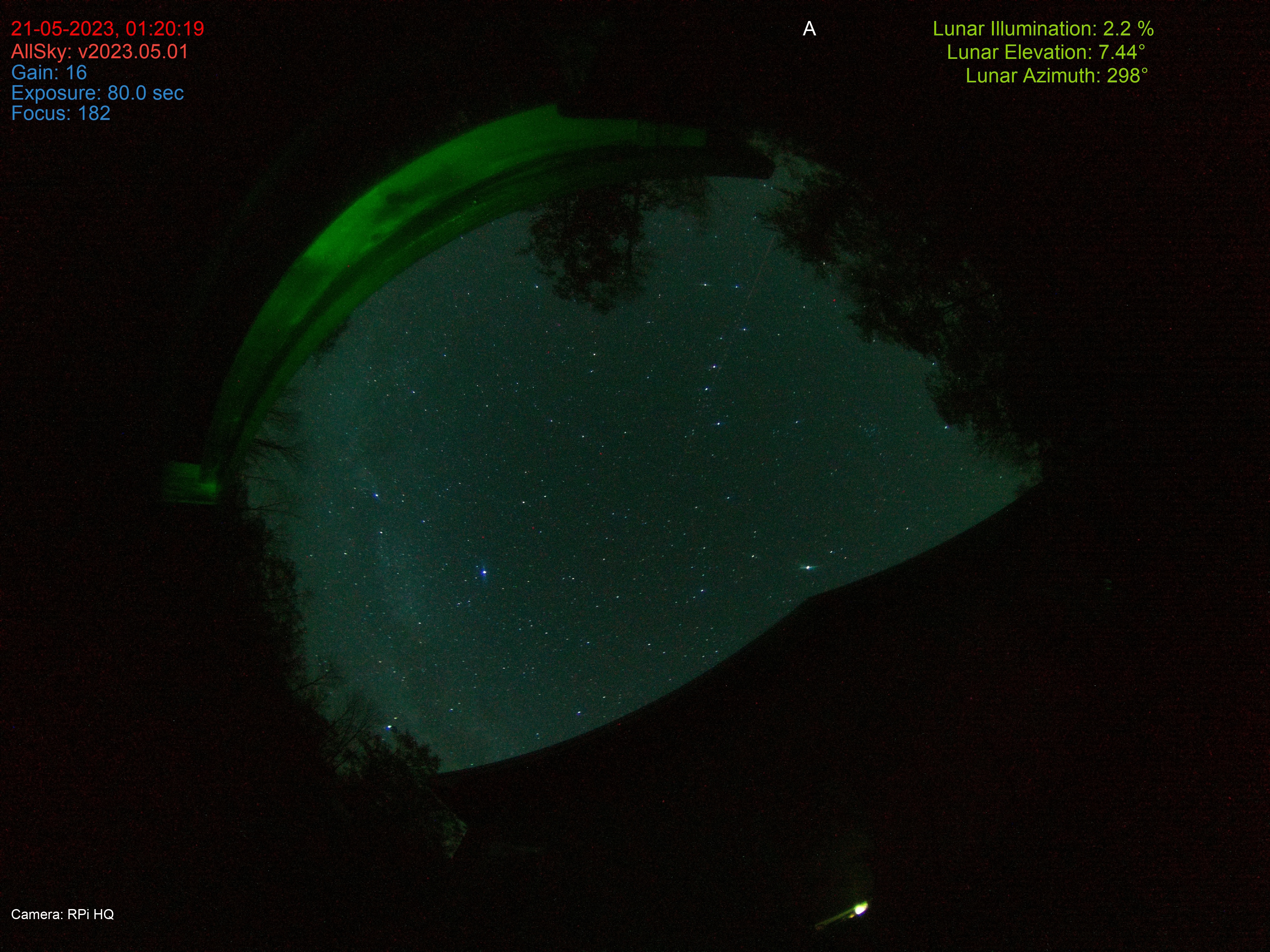
The image below was produced during a test run of an all-sky camera based around a Raspberry Pi computer and a Pi HQ camera wrapped in control software from Thomas Pacquin and available via GitHub. The images were taken from my cottage on the Saugeen Peninsula, Ontario, which is nominally a Bortle 2 site.* I’m right on the border from Bortle 2 and Bortle 1, and I like to think of it as a Bortle 1.5 site – i.e., very dark.

*Bortle numbers are a measure of the sky visual quality based around the level of light pollution on a scale 1 to 9, with 9 as the worst level. <https://en.wikipedia.org/wiki/Bortle_scale&gt;

The Milky Way is visible with dark lane on the left side of the image and the Summer Triangle is just rising. North should be at the top, but I was slightly off in placing the camera – rotate the view slight clockwise. You can find the pole by following the pointer stars of the Dipper to Polaris, just to the left of the tree at the top of the frame.

Normally when we look at a map with North at the top, West is to the left of the map, but in this image that’s not the case. Remember, the camera pointing straight up! East is on the left side of the image, so your viewpoint is a little skewed – disorienting, if you will.

To get the correct perspective here, try holding your copy of the image above your head with north up and aligned with the pole. East and West will then be in the “normal” positions.

You should be able to double-click for a larger view in most browsers.
RPTattersall©2023

Staggering from one post to the next…

Well, no, not really—it’s a bit of a metaphor: the posts are those made to this little blog, and I’m still not doing well in making posts at regular intervals.

On the other hand, the staggering is real: I’m currently experiencing intermittent episodes of dizziness, particularly when switching between horizontal and vertical positions. Getting up in the morning or falling into bed at night have become problematic activities since the entire world appears to swing into motion and spins for a while before settling down – in other words, I’m experiencing vertigo.

According to various reliable (?) medical sites this is most likely due to benign paroxysmal positional vertigo, BPPV, one of the most common causes of vertigo, especially in decrepit individuals over 50 (which would be me), and most commonly in females (not me, I think, based on the last time I checked, but then what do I know?). Here’s my understanding of the cause:

Normally there’s a labyrinthine structure (semi-circular canal) in the ear which keeps track of the movement of the head by detecting swirling fluids in the labyrinth. Change orientation too fast and tiny hairlike sensors in the labyrinth pick up the swirling motion and report the movement to the brain, which then coordinates the signal with other messages and confirms, “Yep, we’re moving around.” Or not: when the swirling doesn’t track with the other signals the brain reports a problem, and you feel dizzy, sometimes to the point you feel nauseous. To avoid this sensation, we learn as kids not to spin around too much – a little can be mildly entertaining, but a lot can be more than a little unpleasant.

There’s another structure in the ear, the otolith, which is also concerned with head movement. It monitors tiny crystals to figure out how you are positioned with relation to gravity. Unfortunately the crystals can leave the otolith and blunder into the semi-circular canals.Once there, they interfere with the swirling fluids and fool the semi-circular canals into reporting movement – and whoops! – everything seems to be spinning. This can last anywhere from seconds to hours (my episodes last no more than a minute, so far). It’s not usually harmful, just inconvenient, so we label it benign. It also comes on suddenly and can go away just as fast, so we term it paroxysmal – thus it’s a benign but paroxysmal attack of vertigo triggered by changes in position, or Benign Paroxysmal Positional Vertigo, BPPV for short. Think of it as dizziness caused by the rocks in your head.

Fortunately there are corrective actions and procedures you can follow which will move the crystals out of your semi-circular canal and relieve the symptoms. The canalith repositioning procedure can be done by a specialist, but patients can also do this at home. Unfortunately you first need to be taught the procedure, and in these days of COVID precautions getting access to a therapist who can teach you is a touch problematic

There are surgical steps if the canalith repositioning doesn’t work. This involves plugging the semi-circular canals so the crystals don’t wander in, and it has a success rate of about 90%. So far the emphasis in my (presumed) BPPV has been on benign, so I’ll wait until a therapist is available. It’s cheaper than getting ‘falling-down drunk!’

Tat, tap, tap. Is this thing on?

Mea culpa mea culpa mea maxima culpa!

I confess, O Gods of the Intertubes, that I have been remiss in my posts.

It has been three years since my last update.

Now, perhaps that’s less of a sin than it could be: there are many many more crappy posts than anyone can encompass (hell, The Turnip has an entire mini-universe dedicated to him as the anointed of God [apparently Turnip-heads think God—assuming He exists—has nothing to do but anoint low-level grifters and con artists as His representatives [see also Prosperity Gospel]]) and we’ve all been hurtling down the Rabbit Hole since the Republicans lied, cheated, and gerrymandered their way to victory in 2016. Whew! Long sentence – let’s skip to a new para!

So, 2020 rolls around, the Repugnant Ones get complacent and believe their own propaganda, and we wind up with a Democrat in the White House again. As the droids of Turnip’s ramshackle machine gape in astonishment the Supreme Leader (now starring as Humpty Dumpty) declares himself the winner anyway (because really, who wouldn’t choose him as the most obvious PoS to be President?) – and his followers delude themselves into accepting that. [SEND ME ALL OF YOUR MONEY. IGNORE THE MAN BEHIND THE CURTAIN!] Cue slow insurrection, currently ongoing….

Oh? Apparently it’s time for my meds again.

Posted in Uncategorized | 1 Reply

Problems

It’s been a while. Again.

I have two sites, but one is completely down and will have to be reinstalled. For the other (this one [!]) I have only now reset the password through the WordPress website: resets through my tablet app were unsuccessful.

So now, perhaps, I’m back. It’s late in my day, so I’ll defer a true update until tomorrow. Or the next day….

Mist on the Yangtse

E39FB072-E18A-4624-B2C4-DB26B8BF4450

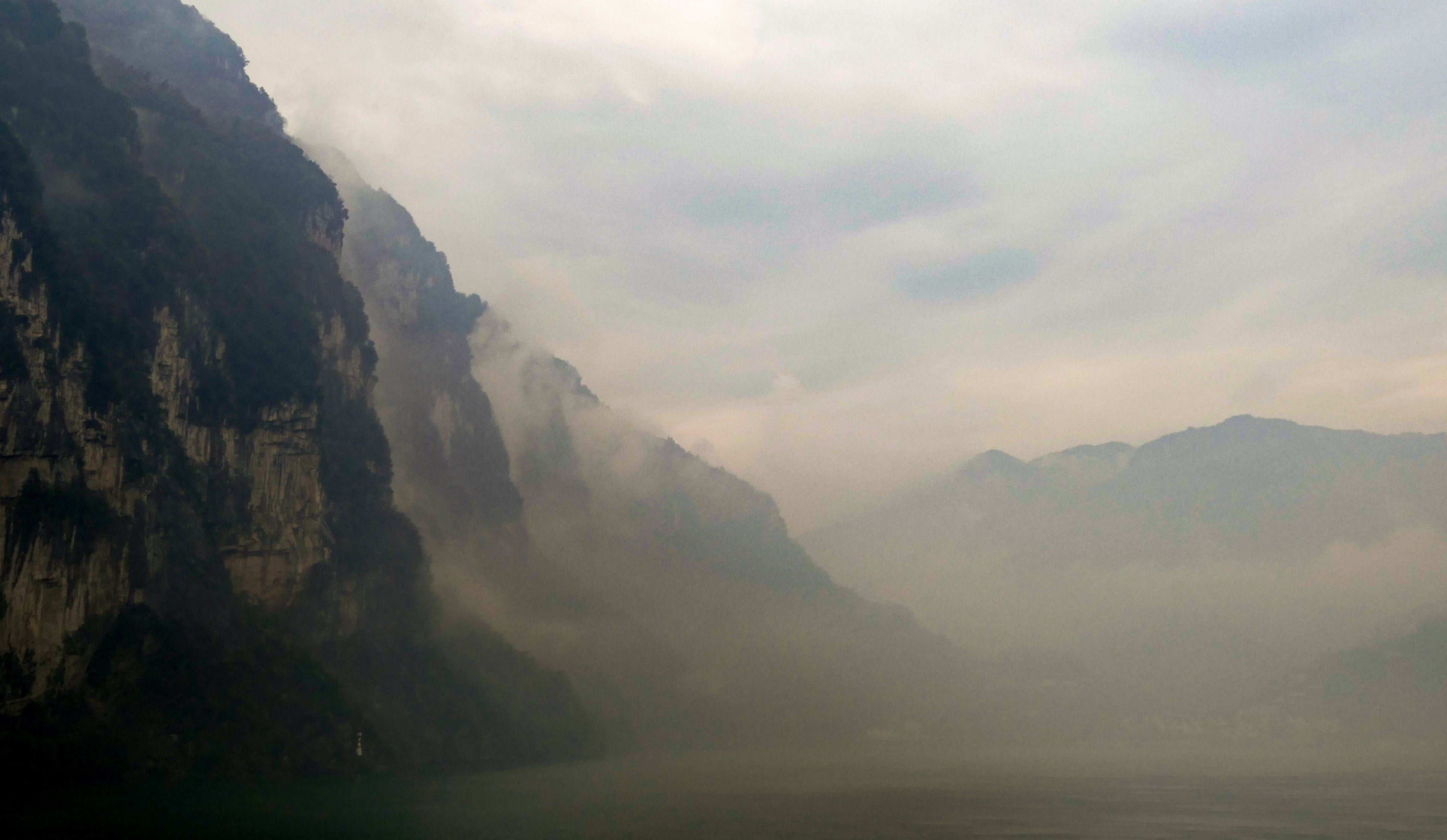
A while back we took a two-week trip through China. During the river trip the fog rolled in and we were unable to travel for several hours. Eventually the fog began to lift, and I captured this image….


Refurbishing the telescope suite

The last time I added to this irregular journal I said I was going to be working on a number of internal projects – updating floors, for example. While that’s still part of the plan, there have been a couple of adjustments to the schedule.

In particular, over the past few weeks my wallet and bank account have been suffering multiple hemorrhages as I purchased a new telescope, a dedicated astronomical camera, and a passenger van. The van is to be converted into a recreational vehicle and telescope transport. That’ll allow me to visit my daughter in California from time to time as well as travel to dark sky locations and star parties and flit about with Daniella to see parts of the continent we’ve been missing over the past few decades.. You can follow the conversion process here, and eventually some notes on astronomy and our travels will probably show up there also.

As for the telescopes, it’s been getting harder and harder to see anything worthwhile through my eyepieces, but my vision is still good enough for me to work on a screen. Last year people were kind enough to suggest I look at video astronomy, and a couple of months ago I picked up a camera. As it turned out, my old SCT wasn’t quite up to handling the large chip size on the camera I purchased, so I upgraded to a newer version of the scope which could. One more thing led to yet another more thing, and I bought a new mount. I have yet to sell the old equipment – which except for the limitation revealed by the large chip still works quite well – but sometime I’ll get around to doing something about my procrastination (but not just yet) and I’ll put them up for sale. I really have to do this – I will need to spend even more money refurbishing and equipping the van, so I have to dig up the cash. I just hate to let go…

Erm. Scheduled, but late: busy, busy….

This post was supposed to have been made a couple of days ago. In fact it was scheduled, and my Reminder app duly rang its little bell, but in the press of events (which for the life of me I can no longer recall, so important were they), I allowed the moment to pass. Still, this is the first time in months that I have posted so soon after another post. And what have I to say for myself? Well….nothing to do with cameras, computers, or astronomy…

I have spent a good deal of time in the past few weeks making changes to my house, first in the dining room and (so-called) living room, putting in a new floor, and then in the kitchen (the real living area), doing a little work putting finishing touches on a vent installation and reworking the video screen, but mostly admiring the paint work Daniella has done in re-coloring the kitchen cabinets and renewing the walls themselves. While I was busily cutting floorboards and fitting them carefully into position, Daniella was also painting the living and dining rooms as well as the main entrance area, for a fairly major transformation of the look of the house. Since the family room and main floor washroom were updated last year, the only rooms left to be done on the main floor are my office area and the mud room/laundry room.

And those will probably be my make-work projects for the next few months (until the Raspberry Pi finally shows up).

Scheduling updates? Might work…. And a comment on LX-7 uses

I really must add an item to my Reminders list. Otherwise this blog will only be updated when I run across the maintenance app on my iPad, and that is becoming a rare occurrence as my iPad habits become more ingrained.

And while I’m here, let me note that posting and updating through the app has been a lot smoother than trying to connect over Safari on the iPad, where any attempt to go back and modify a post has resulted in a crash. I haven’t tried to make edits in quite a while, so I’m not certain whether this is new behavior or not, but it’s certainly irritating right now.

I’ll try to post a couple of LX-7 images in the next week or two. I picked one up through Kijiji a couple of weeks ago, but I haven’t done much with it yet as I am wrapped up in a reno project at home. I can say that the improvements over the LX-5 are somewhat mixed in value. The lens is better, but I can’t attach the camera to a telescope anymore. I was trying out the LX-5 for solar observations (difficult to get the exposure correct) and had hoped to replace that camera entirely, but it looks as though I’ll have to hang on to it until someone figures out a method for attaching the LX-7 to a scope. Bad news for birders, I suppose, but not a major disadvantage for other users.