At the end of the year I picked up a SeeStar S50, a “smart telescope” which under the control of a mobile phone (recent models of iPhone or Android) can collect and process Astronomical images more or less on demand. Even under the light dome of a major city (Bortle 8 or 9 in my suburban location, depending on the night) it can punch through the city murk and give you an image of places so far away that mankind wasn’t even a twinkle in an Australopithecus’ eye when the light left that far-away place. That’s not as remarkable as it sounds, since anyone far enough away from a city can do the same thing just by finding the most visible galaxy (M31) in Andromeda (there are in fact many galaxies in every part of the sky, but M31 is both large and bright since it’s close to us). If you do that, you’re looking back in time.
What is remarkable is that the S50 can do that even in the bright lights of a city, taking a series of brief exposures and then adding the signals of the light captured by each sensor in each image, compensating for the murky atmosphere and bright city light, and from that creating a final image of what could have been visible before. [This is not AI. It is a lot of work done faster by a computer than a human could have done without getting exceedingly numbed by the boredom of the task.] Intelligence came into play in the design of the process, and comes further into play when the automatically captured image is then enhanced by a human being (adjusting contrast, colour balance, saturation, brilliance, etc. for esthetic reasons). For those who’d like to complain that it’s been “photoshopped” I will point out that a lot of published photographs are adjusted this way and have been for many years before Photoshop lurched its way out of a computer science lab. Check out Ansel Adams’ prints which were worked on for days and weeks until Adams was satisfied with the way they looked. It’s not fakery, it’s Art.
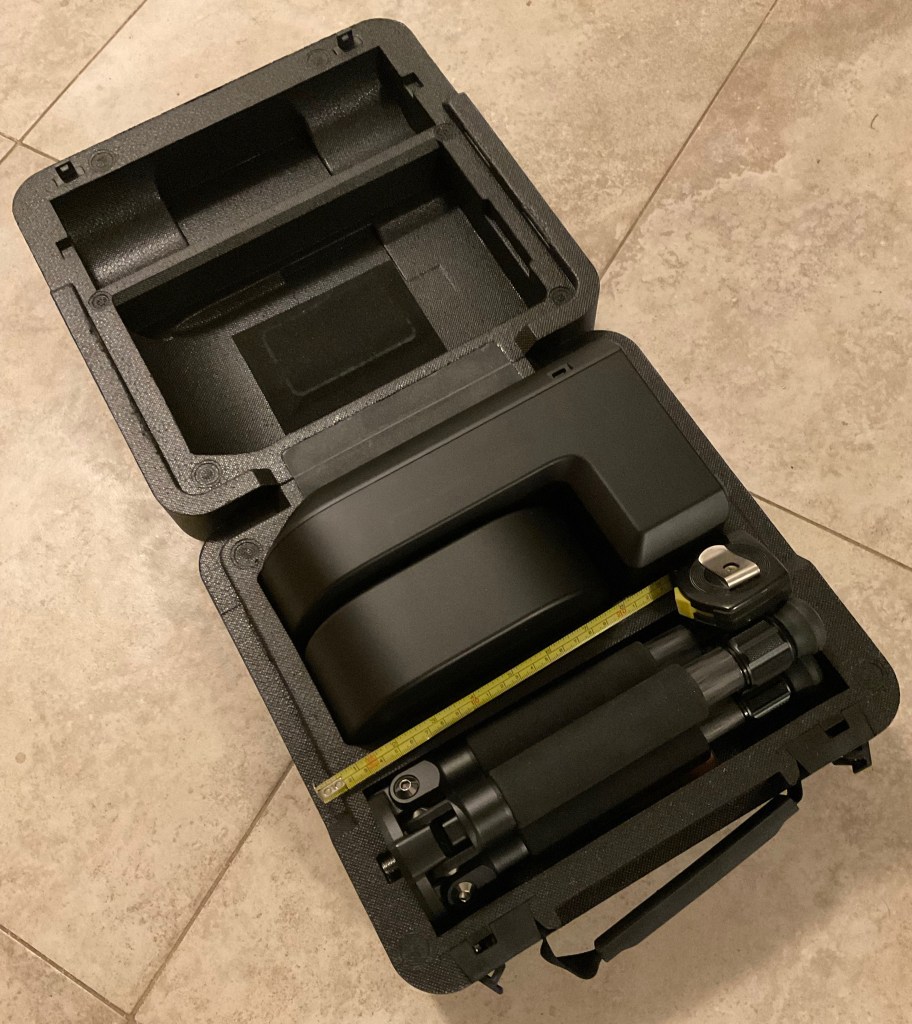
So, back to the S50 and its automatic long exposures… The S50 is a 50mm refracting telescope which is folded (with mirrors, or rather, a prism) so the light is kept within a 5”x7”x2½” black box which also contains a camera sensor. The sensor captures an image and sends it to a computer which processes it—while also controlling motors to keep the telescope pointing at the same point in the sky for as long as the operator-imager wants to keep taking pictures. And it doesn’t do a bad job of processing the image—which can, as noted, be further improved to the imager’s satisfaction with a little additional computer help. The image from this 50mm telescope is several levels better than can be seen with the naked eye because of the long effective exposure (which captures stars too dim to be seen with a naked eye view through the same scope) and the computer program (which helps remove the bright light of the city, murky city skies, and even some very light clouds which may obscure parts of the image during the long series of exposures.
The S50 is not the only “smart telescope” around. There are others, at prices ranging from hundreds to thousands of dollars, and with varying abilities. Since they are computer driven they can be improved by improving the computer programs, and, at least for the S50, those improvements are sent over the internet, without charge (so far, no subscription fees [my current bête noir]).
More to come in following posts …with images and additional equipment updates!
 Considering pebbles