An S50 mosaic image

Flame and Horsehead Nebulae

This is an image from the SeeStar S50 captured around October 27 2024 in alt-az mode with mosaic imaging. Mosaic imaging means that the image is larger that the normal capture frame (in this case, about twice as big) so the system captures a number of images around the central frame and then merges the images together for the final picture. Alt-az means the telescope is oriented with axes pointed to the zenith and parallel to the horizon.

This is a fairly noisy image and took quite a while to capture, but you will note that there are no obvious rotational artefacts. The S50 first captures a central image, then spirals in a clockwise direction to fill in the edges, with the process repeating until capture is stopped. The central part of the image is therefore captured multiple times with the edges of the frame having a lesser number of captures. Image captures were eventually blocked by the house, so the time was somewhere around 22 minutes for the entire process – not a particularly long time.

I’m trying to set the same region up for an equatorial mode capture, but the Horsehead Nebula is a little south of the equator, and one limitation of the SeeStar software used in equatorial mode is that objects below the celestial equator are considered as being below the horizon and can’t be captured. There may be workarounds…

Even though this is a noisy capture, you can see that the dark Horsehead is superimposed over a brighter red glow caused by hydrogen gas ‘excited’ by the light of nearby stars. On one side the number of stars is much higher than on the other: the darker area is covered interstellar dust which blocks the light from stars in the background. There’s a lot of dust in this area, and longer exposures will reveal more details – the dust reflects a little light from nearby stars, but not enough to be seen in this short capture.

For a comparison, the image below was captured in December 2023 with the default Seestar framing.

/
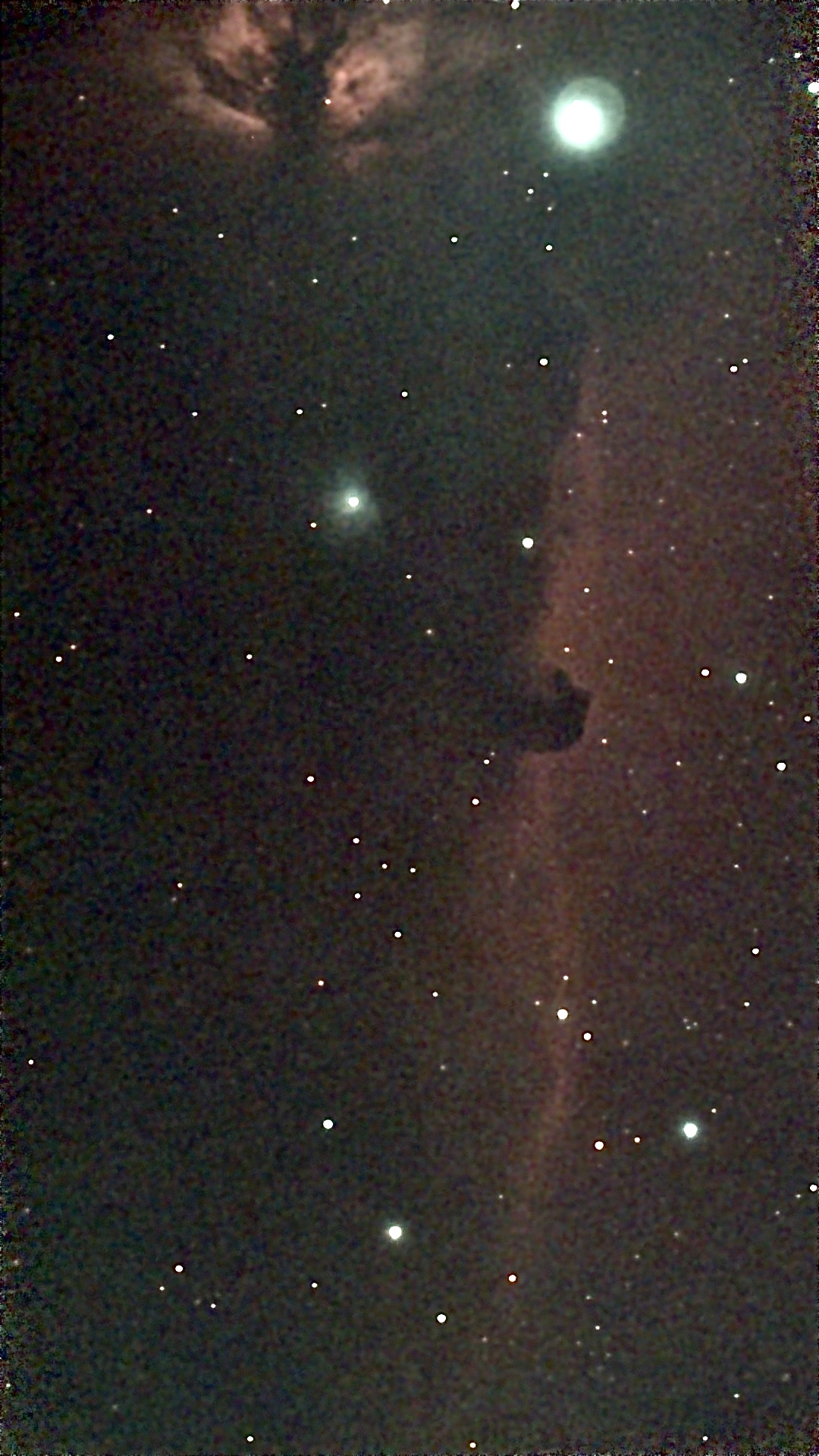
Same general area, but smaller size frame.

[Note that clicking on the images should increase the magnification so you can pixel-peep]
Gearing up!

At the end of the year I picked up a SeeStar S50, a “smart telescope” which under the control of a mobile phone (recent models of iPhone or Android) can collect and process Astronomical images more or less on demand. Even under the light dome of a major city (Bortle 8 or 9 in my suburban location, depending on the night) it can punch through the city murk and give you an image of places so far away that mankind wasn’t even a twinkle in an Australopithecus’ eye when the light left that far-away place. That’s not as remarkable as it sounds, since anyone far enough away from a city can do the same thing just by finding the most visible galaxy (M31) in Andromeda (there are in fact many galaxies in every part of the sky, but M31 is both large and bright since it’s close to us). If you do that, you’re looking back in time.

What is remarkable is that the S50 can do that even in the bright lights of a city, taking a series of brief exposures and then adding the signals of the light captured by each sensor in each image, compensating for the murky atmosphere and bright city light, and from that creating a final image of what could have been visible before. [This is not AI. It is a lot of work done faster by a computer than a human could have done without getting exceedingly numbed by the boredom of the task.] Intelligence came into play in the design of the process, and comes further into play when the automatically captured image is then enhanced by a human being (adjusting contrast, colour balance, saturation, brilliance, etc. for esthetic reasons). For those who’d like to complain that it’s been “photoshopped” I will point out that a lot of published photographs are adjusted this way and have been for many years before Photoshop lurched its way out of a computer science lab. Check out Ansel Adams’ prints which were worked on for days and weeks until Adams was satisfied with the way they looked. It’s not fakery, it’s Art.

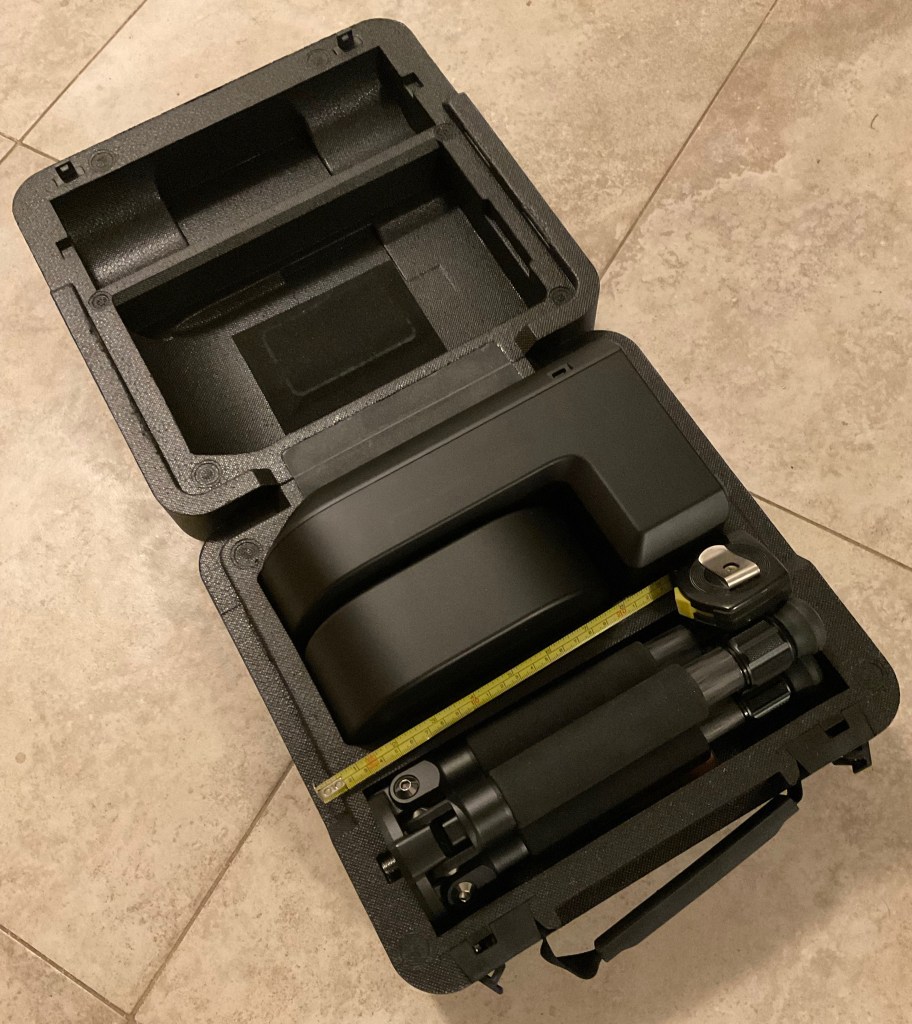
SeeStar S50 in its case (included). There’s a small tripod and underneath that, a solar filter.The tape measure is shown for scale. Motors and computer are in the L-shaped section, but the telescope and camera are folded into the smaller black box.

So, back to the S50 and its automatic long exposures… The S50 is a 50mm refracting telescope which is folded (with mirrors, or rather, a prism) so the light is kept within a 5”x7”x2½” black box which also contains a camera sensor. The sensor captures an image and sends it to a computer which processes it—while also controlling motors to keep the telescope pointing at the same point in the sky for as long as the operator-imager wants to keep taking pictures. And it doesn’t do a bad job of processing the image—which can, as noted, be further improved to the imager’s satisfaction with a little additional computer help. The image from this 50mm telescope is several levels better than can be seen with the naked eye because of the long effective exposure (which captures stars too dim to be seen with a naked eye view through the same scope) and the computer program (which helps remove the bright light of the city, murky city skies, and even some very light clouds which may obscure parts of the image during the long series of exposures.

The S50 is not the only “smart telescope” around. There are others, at prices ranging from hundreds to thousands of dollars, and with varying abilities. Since they are computer driven they can be improved by improving the computer programs, and, at least for the S50, those improvements are sent over the internet, without charge (so far, no subscription fees [my current bête noir]).

More to come in following posts …with images and additional equipment updates!

iPad app for Astronomy

Before anything else, let me report that I am trying to update using the WordPress app, and it’s not the most stable app in the world. I’m running a couple of very low volume blogs, and this one managed the get sufficiently screwed up on the app that just trying to access the posts resulted in the app crashing. Treating the blog as a brand new one allowed me to rebuild the settings and get access again. We’ll see how long that lasts.

OK, the real point of this post is that I managed to try SkyVoyager in it’s latest incarnation on the iPad, and it’s a dual iPad/iPod release. The full screen display is infinitely better than the cramped iPod display (even expanded using the 2x option), and the expansion pack allows me to see almost as much as I would on the desktop using my old Starry Night application. Since I don’t have a 3G iPad, I couldn’t check out the compass and orientation features but based on the demo from MacWorld 2010 that should be a useful item on the 3G version. I’ll be interested in seeing what a suitably equipped user has to say later in the year. [May 2 – As I found after posting, the compass and orientation can be enabled even on a WiFi iPad, but at least for me, the compass wasn’t accurate enough to be useful]

Another interesting but so far untested feature on offer is Telescope Control. If I can extend myself and pick up Carina’s SkyFI accessory, I would/will be able to run my Losmandy Gemini mount from my iPad, leaving my laptop at home for the evening, using my regular photographic cable timers to grab the imaging shots I want. That’s cool, but also useful, and I just may go for that.